Spotlight on Impact: Healthcare

In this edition of Spotlight on Impact, we focus on the impact theme of Healthcare - one of the most fundamental human needs and, as it turns out, one of the more complex impact investment landscapes. We explore how Anthos thinks about the opportunities that provide exposure to this impact theme and why emerging markets are our primary frontier, and what it takes to find companies where commercial success and positive health outcomes genuinely reinforce one another.
Our overarching mission in Healthcare, is to address the unmet needs of people, communities and the planet by providing access to essential products and services that are affordable and of good quality, and which contribute to positive social and environmental impact at scale.
Healthcare: Where to Start?
Healthcare is a vast and heterogeneous sector. At its broadest, we think about impact investment opportunities across four dimensions: access, affordability, quality, and innovation. In emerging markets - our primary focus - the most pressing gaps cluster around the first two, though digital technology is increasingly reshaping how care is delivered and medicine is distributed.
The sector spans a wide range of sub-verticals: pharmaceutical distribution; diagnostics and diagnostics-enabled care; hospital infrastructure and primary care networks; digital health and health technology (including telemedicine, AI-assisted clinical assessment, and electronic health records) along with maternal and child health, elder care and community health worker models. The most compelling impact opportunities tend to sit at the intersection of high unmet need and scalable commercial models - where serving more patients or more rural pharmacies is not a cost of doing good, but the engine of the business itself. Sub-Saharan Africa, South and Southeast Asia, and parts of Latin America represent the regions where gaps are widest and the opportunity for private capital is most acute.
Our investments align with SDG 3 sub-goals1: 3.1 & 3.2 (maternal and child health); 3.3 & 3.4 (communicable and non-communicable diseases, mental health); and 3.8 & 3.9 (access to medicines, R&D, and affordable healthcare facilities).
Why Investing in Healthcare Matters
The World Health Organisation recognises access to healthcare as a fundamental human right. Yet the UN's 2024 SDG Report confirms the world is not on track to achieve SDG 3. 25 million children missed life-saving vaccines in 2022. Sub-Saharan Africa and Southern Asia are responsible for 87% of global maternal deaths2,3. Deaths from tuberculosis and neglected tropical diseases are rising. And in 2024, governments in low-income countries spent just $17 per capita on health - less than a third of the $60 minimum needed to deliver essential services4.
Private capital, directed with discipline, has a significant role to play. Growing middle classes, expanding health insurance coverage, and increasing mobile connectivity are creating fertile ground for scalable, commercially viable health businesses that can generate strong returns while delivering meaningful impact.
What Impact looks like in Healthcare
Investments in better health outcomes carry economic multipliers beyond the clinical setting. When healthcare access improves, workforce participation rises, productive days lost to illness decline, and household expenditure shifts toward savings, education and consumption - all feeding broader economic growth. We seek measurable improvements across SDG 3: improved immunisation rates; reduced deaths from infectious and non-communicable diseases; stronger maternal and child outcomes; and expanded access to essential medicines and quality primary care. Critically, we look for impact at scale - companies whose model makes growing their reach and growing their revenues the same thing.
Our Theory of Change
Capital is deployed into funds and companies that improve access to, affordability of, and quality of healthcare - particularly for underserved and base-of-pyramid populations. Those companies generate outputs: medicines distributed, patients treated, clinics opened, pharmacies connected, caregivers trained - producing outcomes of lower preventable mortality, improved chronic disease management, greater economic participation, and ultimately meaningful progress toward SDG 3.
How This Works in Practice at Anthos
One way we place this theory to work is through our allocation to Asia Impact Investment Fund II (AIIF II), managed by UOB Venture Management (UOBVM). AIIF II invests in early-to-expansion stage companies across Southeast Asia and China serving base-of-pyramid populations. Healthcare is the largest sector allocation - nearly 20% of invested capital - across three companies: EverLife Healthcare (China), Tianyu Infinity Wellness Technology (China), and Buymed (Vietnam, Cambodia, Thailand).
BuyMed: Reimagining Pharmaceutical Distribution in Vietnam
Founded in 2018, Buymed Pte. Ltd. (brand: Thuocsi in Vietnam) was built around a simple diagnosis: the pharmaceutical distribution market across Indochina was fragmented, opaque and deeply inefficient. Independent pharmacies - accounting for 97% of medicine sales through the pharmacy channel in Vietnam - were cut off from competitive pricing, comprehensive ranges and reliable supply, with consequences falling hardest on rural patients. Buymed's answer was Vietnam's first B2B e-commerce platform for pharmaceutical and care products, connecting pharmacies, clinics and hospitals with over 1000 suppliers, offering 26,000+ SKUs, real-time pricing, recall alerts and doorstep delivery.
| Impact Metrics | At Investment (Oct 2022) |
As at Dec 2025 |
| Active pharmacies in rural areas | 12,308 | 19,287 |
| BoP patients in Vietnam reached through Buymed | 4,098,564 | 6,422,571 |
Source: UOB Venture Management (UOBVM) and Anthos Fund & Asset Management including Anthos investment team analysis, and BuyMed company data.
BoP patient figures are derived from BuyMed company data, with the BoP porportion based on the Vietnam Statistics Office data (2019): 60% of rural population classified as base-of-pyramid.
The Human Story Behind the Numbers
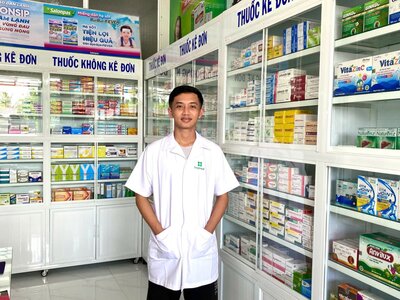
Mr. Do, Pharmacist, Vị Đông, Hậu Giang Province, Vietnam
In April 2022, Mr. Do, a young pharmacist, returned from Ho Chi Minh City to his hometown in Vị Đông, Hậu Giang province. He serves an estimated 3,000 residents, treating conditions from respiratory disorders to diabetes. Having used Buymed in the city, he adopted it from day one - now sourcing 55% of his inventory through the platform with 2.5 times more SKUs than previously available. When a patient with a rare brain condition could not find medicine locally, Mr. Do sourced it within days through Buymed, saving a trip to Ho Chi Minh City costing over VND 4 million (~EUR 130). His pharmacy is now known as the place for “hard-to-get” medicines.
“Before BuyMed, many of my patients had to travel to Ho Chi Minh City for certain medicines. Now I can source them here in town, saving patients both time and money, and helping them start treatment sooner.”
- Mr. Do, Pharmacist, Vị Đông, Hậu Giang Province, Vietnam
Active Ownership
At Anthos, we look for fund managers who take active ownership of their portfolio companies seriously. The AIIF II team has been exemplary: supporting Buymed's transition to a clearer first-party/third-party distribution structure, introducing product assets including exclusive dealership rights for children's supplements and ophthalmic lenses, and in 2024 co-facilitating a four-month strategic engagement with students from the University of St. Gallen and Singapore Management University. That engagement produced a framework for Buymed's Southeast Asian internationalisation - covering regulatory landscapes, urban-rural medicine access dynamics, competitor mapping and logistics requirements - which directly informed the company's longer-term planning. In 2025, the AIIF team partnered with the Company over a nine-month engagement to develop and publish its inaugural impact report — drawing on structured surveys and direct interviews with 285 pharmacy partners, predominantly in rural communes, to establish a clear baseline of impact delivered to date and a foundation for measuring outcomes going forward. Anthos has been a member of the fund’s LPAC since 2023.
A Final Thought
Healthcare investing in emerging markets is not a niche within impact investing - it is one of the most urgent and commercially compelling frontiers in the asset class. The unmet need is vast, the addressable market is growing, and companies with models to serve that need profitably, at scale and with measurable outcomes represent exactly the kind of opportunity Anthos was built to find. Buymed is one illustration. There are many more. We look forward to sharing further in future spotlights.
Notes & Sources
1. The Sustainable Development Goals Report 2024, United Nations. SDG 3 – Good Health and Wellbeing. Available at: unstats.un.org/sdgs/report/2024
2. Ibid. Sub-Saharan Africa and Southern Asia account for 87% of maternal deaths worldwide.
3. GIIN Healthcare Impact Performance Benchmark, IRIS+, Global Impact Investing Network. The 4.8% annual growth rate is calculated by the GIIN as the pace required to achieve universal health coverage (SDG 3.8) by 2030. Available at: iris.thegiin.org. The 1.2% rural-focus figure is drawn from the same benchmark (168-company dataset). Note: benchmark data is accessed via the GIIN IRIS+ platform; full methodology available to registered users.
4. World Bank Group, ‘At a Crossroads: Prospects for Government Health Financing Amidst Declining Aid’, November 2025. Available at: worldbank.org
Also interested in our Climate edition? Please follow the link. For our Financial Inclusion edition, please follow the link.